Choose Your Finishes as One Schedule, Not One at a Time
Stone, wood and light only work when you pick them together, because each one changes how the others look.
October 27, 2026 · 3 min read
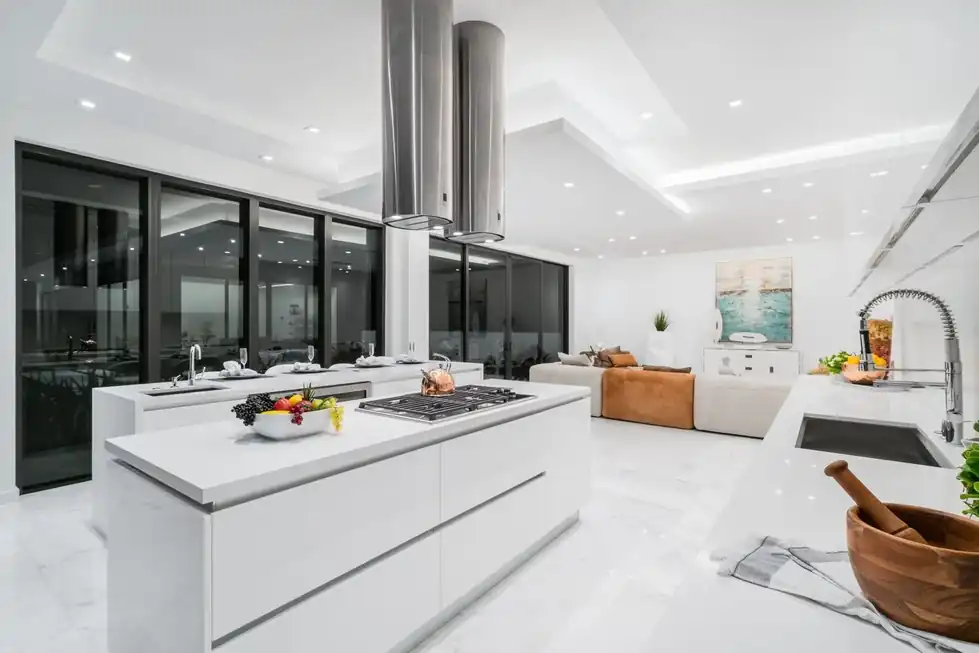
The common way to pick finishes is one trip at a time. A tile showroom on Monday, a stone yard on Thursday, a lighting store a month later. Each choice looks excellent in its own showroom. Then they arrive in the same room and argue. The marble reads cooler than expected next to the wood, the lighting turns the wood orange, and nobody can say which decision caused it.
The fix is boring and it works: treat every finish in a space as a single schedule, decided together, tested together, and signed off together.
Finishes change each other
No material has a fixed color. Marble picks up the tone of whatever surrounds it and of the light falling on it. Wood warms or cools depending on the bulb and on what's beside it. A pale stone next to dark cabinetry looks brighter than it does alone, and a warm wood floor next to cool white stone makes the stone look bluer. You can't judge one finish in isolation because in the finished room it will never be in isolation.
This is the reasoning behind the Interior Design Leadership service at ATR Concepts: selections for finishes, lighting and furnishings made as one cohesive look rather than a stack of separate buying decisions.
Casa Exumas: gold-veined stone against dark wood
In the gourmet kitchen at Casa Exumas on Palm Lane, the countertops are Carrara gold marble and the cabinetry is Brazilian walnut. Look at what that pairing is doing. The walnut is deep and warm, a strong visual mass. The marble supplies lightness and a thread of gold in the veining that echoes the warmth of the wood without matching it. Swap either one for something flatter and the other starts to look heavy or cold.
The twenty-five foot ceilings and statement fireplace in the same house set the scale. A kitchen of that proportion can carry a dramatic wood because the volume around it is generous. In a smaller room, the same walnut might want more breathing room in the stone and the lighting.
Lower PH66: restraint in the kitchen, drama in the floor
Lower PH66, a combined residence on the 66th floor of the Four Seasons Residences, takes a different route. The floors are Bianco Ondulato marble, a pale stone with movement. The custom Ornare kitchen carries Calacatta counters. Here the stone shows up in two places, underfoot and on the kitchen counters, and gunmetal accents add contrast without bringing in a second loud material.
Two different white stones in one home can be a risk, since marbles of similar color but different veining and undertone can look like a mistake side by side. The way to avoid that is to see them near each other, in the real light, before anything is ordered. Samples held up together under the actual windows tell you more than any catalog.
Test under the real light
- Carry large samples, not chips. A palm-sized piece of marble hides the veining that will define a countertop.
- Look at the samples in the room itself, in morning light, midday glare and evening, with the lamps you plan to use switched on.
- Check lighting color temperature against the stone and wood. A bulb that flatters walnut can make white marble look yellow.
- Lay samples next to each other on the actual floor and wall, not on a showroom table.
Practical notes on marble and wood
Marble is a living material. It is porous and reacts to acids such as citrus, wine and some cleaners, so sealing it and using stone-safe cleaners is part of the plan, not an afterthought. Honed finishes hide small marks better than polished ones, which show every etch. Ask your stone supplier how your specific slab should be sealed and how often.
Wood in a humid, coastal climate moves with the air. Good installation, correct acclimation and properly sealed finishes matter more here than in a dry climate. Choose the species and finish with that in mind, and keep wood away from constant direct moisture.
Put the schedule on one page
The schedule itself can be simple: one page per room listing floor, wall, counter, cabinetry, hardware, plumbing fixtures, and every lighting fixture with its bulb color. When all of it sits on one sheet, mismatches become visible before they become expensive. If you'd like help assembling that sheet, a Design Consultation is a good place to begin.
ATR Concepts, (786) 723-6041
Call (786) 723-6041More articles
Renovating to Sell or Renovating to Stay: What Changes
The first renovation question isn't what to fix, it's who the house is being fixed for.
What a Home Staging Review Actually Covers
A staging review is a buyer's-eye walk through your home, and it can happen in the house or over video.